
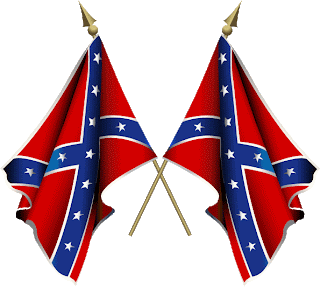
Just recently, I read the following articles concerning the Confederate Flags:
1. http://www.associatedcontent.com/article/93815/confederate_flag_heritage_or_hate.html?cat=37
2. http://www.associatedcontent.com/article/301597/the_confederate_flag_why_it_offends_pg2.html?cat=9
3. http://www.associatedcontent.com/article/344964/heritage_or_hate_a_closer_look_at_the.html?cat=37
I really suggest that you read all three in full and approach each with an open mindset, then weigh them with your own beliefs, but to save you a little bit of time here's a summary of sorts:
The first writer essentially makes the assertion that the Confederate flag contains more history behind it than people commonly associate with it: "The Confederate States was not formed because of slavery. Anyone that wanted a slave owned one.[...] The North was incredibly rich [...]. Congress only allowed the sale of the South's main goods such as cotton and tobacco to Northern factories instead of shipping to other countries. Did the South get any of this back? Well, of course, if they could pay the added tax that the finished products had slapped on them for resale to the South. Oh, by the way, if you think that heavy taxation and no one being there to represent the taxing party [...] That's why the Revolution was started."
He continues stating that the war was more over economic differences which arose more from the dissimilar economies (and work forces) of the North and South than about the slaves themselves.
In his opinion, the flag should be used to represent the thousands of southerns who did not own slaves and died fighting for their rights-- not the ability to keep slaves.
Next, in a semi-comedic tone, the writer of the second article, directly responding to the first, answers the curious first writer's titular question of "Does the Confederate Flag Represent Hate for Other People?"
He boils the resentment of the flag by African Americans to a couple of reasons:
"1. Meaning: [T]he history of the flag had nothing to do with what it has come to mean. [...] he states that the flag stood for bravery because southerners rebelled against what was in essence 'taxation without representation.' While the flag's history may have a noble beginning, the meaning of it has been twisted into something else altogether. [the writer quoting another commenter] 'The flag itself is not the problem or have any true meaning here - it's the hatred in people's hearts or the love in people's heart that makes something MEAN something.'
2. Use of the Flag: The displaying of the flag to us, African Americans, means that you subscribe to a certain ideology. An ideology that is against who we are as a people. [...] Just like you'd ascertain that someone sporting a Nazi swastika is not a fan of, for example, Jewish people, African Americans assume that if you proudly display the rebel flag, then you're probably not someone who is looking to become our friend."
Clearly, being an African American, he views the grass from the other side, and I do empathize with him on some levels although the next writer synced with me the best actually.
The third writer, while in my opinion writing from the most naive mindset, hails from Tennessee and has clearly attached a very romantic theme to the flag:
"The truth of the matter is that this flag represents the heritage of an entire area of our country. It represents men who fought and died to protect it, and families who lost everything they had in an attempt to preserve what they felt was right."
She also faces the slave question head on:
"It has long been argued that the basis for the Civil War was slavery, and I will not even attempt to deny that it was one of the reasons that the civil war was fought. However, the majority of people that fought in this war were not the wealthy plantation owners who owned the majority of slaves. Rather, the people who fought this war were the farmers, the shopkeepers, and the every day people of this era.
There were not only white people fighting for the Confederacy, but there were African Americans as well. Does it make sense that these ordinary people went to war to save an institution that did not benefit them either? That these people were willing to give up their lives for a cause that did not benefit them in any way?
It makes more sense to assume that the cultural differences between the north and the south created a rift. That the rising tensions created by the fact that the industrialized north and the agricultural south had different viewpoints on many issues, including slavery had helped to widen this rift."
She understand the history and the negative associate, but she puts them aside and tries to take the best out of symbol which has a lot of power to it either way.
"How such an important part of our history can be blacklisted as an icon of racism [and] held up as symbolization of a set of ideals, which in no way encompass the actual values of its time is hard to imagine. The Confederate Flag is not a symbol of hate. It is a symbol of the heritage of an entire group of people."
Now that's enough of them. This is my blog isn't it! To me, it comes down to how the symbol is being used. A friend of mine, Christiana R., used to wear a shirt which bared the flag on there, and she thought nothing of it. Why? Because she, a white woman, was not raised to hoist the flag up as a symbol of oppression, but rather a token a Southern pride.
Let's examine the American flag within the same context. Let's not forget that those slaves owners flew that flag before the Civil War. Let's not forget the Congress of that flag decided 5 black slaves only represented 3 whites in order to make representation "fair." Let's not forget that the government of that flag legalized segregation. Let's not forget that Woodrow Wilson, the leader of the United States of America during WWI, was an extremely open racist. Let's not forget the government of that flag secretly conducted inhumane test of Syphilis on black males. Let's not forget that Americans, not Confederates, across the nation turned a blind eye to the mistreatment of African-Americans for decades before AND after the Civil War. Citizens of the United States of America, who pledged to the same flag I, a young black man, does today, have done more harm to African-Americans than Confederates. (And, I'm sure Catholics, Jewish people, Japanese-Americans, Chinese Americans, and LGBT Americans have a few gripes as well.)
Essentially, you have to put the Confederate flag in the context that its being used. It's a symbol of hate when a clansman rides around on a horse waving it while burning a cross. It's a symbol of heritage for every little boy who lost their grandfather to the Civil War when they were too young to understand any of this.
And, to me, it's just a flag until someone else picks it up, then I'll make my judgement.


 Posts

